

The thesis builds on themes explored in CLIC’s earlier industry park study and deepens the understanding of how industrial symbiosis can support the development of the hydrogen economy. The work also marks an important milestone for CLIC. It originated from a practical question: how can planned hydrogen economy projects in Finland be supported, and what factors ultimately determine their economic viability?
Building Expertise Through Research and Practice
Sara joined CLIC as a summer trainee in May 2025. Her work focused primarily on the industrial park study, which mapped potential Finnish hubs for hydrogen economy and Power-to-X solutions. In addition, she contributed to the preparation of EU project proposals, the development of the latest Energy Strategic Research and Innovation Agenda (SRIA), and various support activities for ongoing EU-funded projects.
At LUT University, Sara studied Energy Technology and chose Sustainable Energy Systems as her major in the master’s programme. Her interest in the energy sector stems from a desire to contribute to sustainable development and the green transition.
“I want to do work that has meaning. The energy sector offers an opportunity to contribute to a more sustainable future, while also being a highly diverse and constantly evolving field.”
Sara is particularly interested in the opportunities that the hydrogen economy creates for domestic fuel production in Finland and its potential to enable low-carbon solutions in sectors where direct electrification is not sufficient.
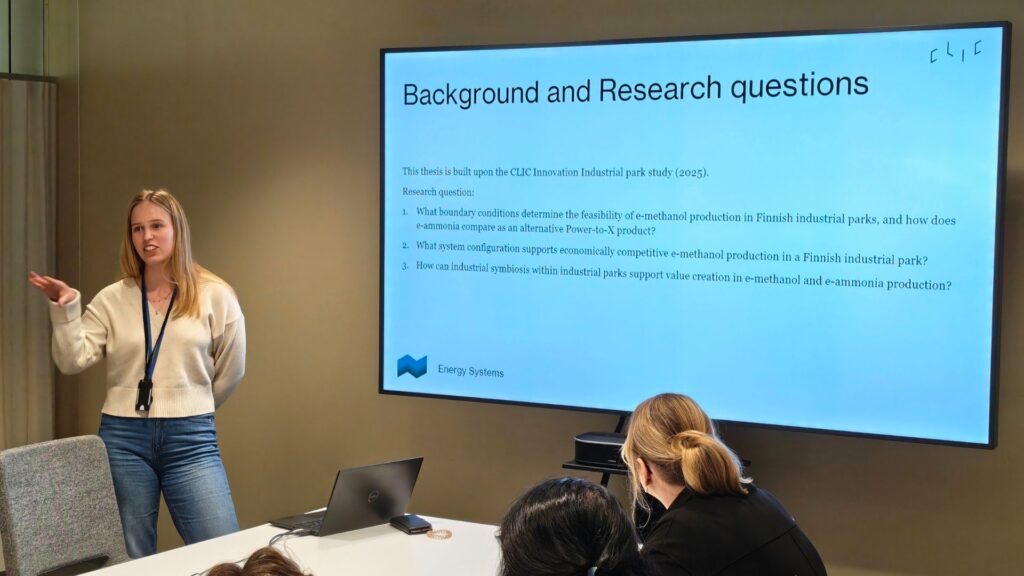
Understanding the Conditions for E-Methanol Production
The thesis topic emerged naturally from the themes of the GreenE2 ecosystem and CLIC’s industry park study. During the study, several regions with strong potential for hydrogen economy development were identified, while numerous questions requiring deeper analysis also emerged.
“There are still several bottlenecks in the hydrogen economy that slow the transition from project plans to investment decisions. We wanted to better understand which factors support the development of the hydrogen economy and which factors limit it.”
The work was built around the development of a techno-economic model capable of evaluating the feasibility of e-methanol production in different Finnish industrial environments.
The industry park study highlighted regions such as Oulu, Turku and Lappeenranta, which were selected as case study areas through the GreenE2 collaboration. These regions provided a basis for comparing different operating environments and their potential to support hydrogen economy investments.
Industrial Symbiosis as a Source of Competitive Advantage
The main objective of the thesis was to assess the economic feasibility of e-methanol production in Finland and to examine how industrial symbiosis can influence production costs.
The results showed that two factors stand out above all others: electricity grid capacity and the availability of biogenic carbon dioxide. These largely determine whether e-methanol production is feasible in a particular region. Electricity price was also identified as the single most important factor affecting production costs.
One of the most interesting findings concerned regional differences. “I expected the differences between regions to be larger. Surprisingly, regional cost differences remained relatively small once the key boundary conditions were met.”
Instead, significant competitive advantages can be created through industrial symbiosis. If industrial areas can utilize side streams, shared infrastructure, waste heat or other collaborative solutions, production costs can be reduced considerably. According to the thesis, under the assumptions applied in the study, industrial symbiosis may have a greater impact on competitiveness than regional differences themselves.
A Supportive Work Community Contributed to Success
The thesis was a comprehensive project, and Sara identifies defining the right scope and making necessary assumptions as its most challenging aspects. “There were almost endless perspectives that could have been explored. The challenge was to find the right scope and make well-founded assumptions for the modelling work.”
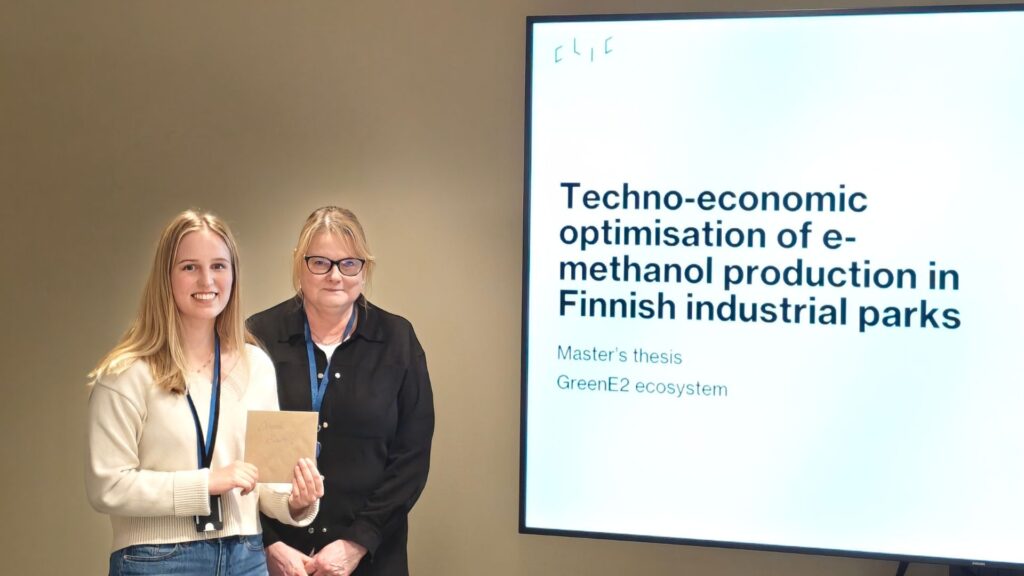
The supportive atmosphere at CLIC played an important role in the success of the project. “The work community was extremely encouraging and created a great environment for learning. In particular, my supervisor and manager, Pia Salokoski (in above picture), always found time for discussions. We had many interesting exchanges throughout the project, and the collaboration was genuinely inspiring.”
Sara hopes that the thesis will serve above all as a conversation starter within the CLIC network. “The next step would be to hear companies’ perspectives on what successful industrial symbiosis requires in practice. There is significant potential in this topic to create new forms of collaboration.”
The work provides a concrete foundation for discussion on how hydrogen economy projects can be developed more effectively and how the existing strengths of industrial areas can be better utilized to support the green transition.

Looking Ahead
Graduation feels both exciting and bittersweet for Sara. “Graduating feels fantastic, but also a little nostalgic. My years studying in Lappeenranta were a truly enjoyable time.”
Completing the degree marks the end of one important chapter and the beginning of another. “My studies are now complete, and the next phase is working life.” When asked to summarize her thesis in a single sentence, Sara’s answer also captures its broader significance: “An insightful exploration of the opportunities created by industrial symbiosis.”
We congratulate Sara Simell on her graduation and thank her for her valuable contribution to advancing Finland’s hydrogen economy, industrial ecosystems, and green transition.
Related links
For more information