

Europe has learned how to build innovation ecosystems. The harder question is who governs the transitions they’re meant to deliver.
In our previous blog, “The Super Partnership for Europe’s sustainability transition”, we argued that Europe needs stronger and more integrated partnership models to bridge the gap between research, innovation and large-scale deployment.
We also highlighted the need for more integrated approaches capable of connecting innovation, deployment, investment and market creation.
The central message was clear: Europe’s sustainability transition cannot succeed through fragmented innovation efforts alone. It requires long-term coordination across policy domains, institutions, industrial sectors and value chains.
Yet while reflecting further on Europe’s ongoing industrial and energy transitions, another question emerged:
Even if partnerships successfully build innovation ecosystems, are Europe’s governance structures themselves prepared for managing systemic transitions?
This question is highly relevant in current European discussions around the revision of the Governance Regulation and the future governance of Europe’s energy and industrial transitions.
The transition challenge is no longer only about setting targets. It now also concerns the coordination of implementation across policy domains and investment frameworks.
This is particularly evident in areas such as hydrogen, industrial decarbonisation and circular economy transitions, where the challenge is no longer primarily technological, but increasingly institutional, market-related and societal.
From this perspective, the debate may no longer be only about partnerships, but about who actually governs transitions in practice.
Where does the governance mismatch lie?
Europe is currently attempting to orchestrate transitions that are simultaneously industrial, geopolitical, economic and environmental.
Yet governance structures remain largely organised around sectoral policy boundaries.
Hydrogen illustrates this complexity particularly well. Hydrogen is not simply an energy carrier. It is simultaneously an industrial feedstock, a transport solution, an infrastructure challenge, a strategic resilience issue, and increasingly a geopolitical and societal transition issue.
This places hydrogen at the intersection of multiple policy domains.
Administrative systems, however, are still largely organised around sector-specific mandates and institutional responsibilities. This is hardly surprising.
The challenge is that systemic transitions do not follow administrative boundaries.
As a result, transition governance may unintentionally emphasise certain policy objectives — such as energy security, decarbonisation or industrial competitiveness — while giving less attention to other sources of societal and economic value and to some of the conditions required for long-term transformation, including financing, legitimacy and regional realities.
Can ecosystems alone govern transitions?
European partnerships have already strengthened ecosystem-level coordination considerably. Compared to traditional research-driven approaches, today’s partnerships are far more collaborative, mission-oriented and deployment-aware.
Strategic Research and Innovation Agendas (SRIAs), for example, often involve broader stakeholder participation than traditional policymaking processes.
New collaborative models are also emerging around the partnerships. Hydrogen Valleys already demonstrate this. They connect actors across sectors and regions, build trust, and help align investments.
But valleys or ecosystems alone cannot scale markets or govern transitions.
Hydrogen offers a particularly clear example. Scaling hydrogen systems requires long-term coordination across infrastructure, investment, markets, public legitimacy and policy continuity.
In addition, the challenge becomes fundamentally systemic because hydrogen and its derivatives may simultaneously contribute to industrial competitiveness, strategic autonomy, food security, green industrial feedstocks, energy resilience, and decarbonisation.
The question is therefore no longer only how to support innovation or strengthen ecosystem collaboration. It is also how to coordinate transitions across fragmented governance structures.
Towards a more realistic transition governance model
The growing complexity of systemic transitions also raises a broader question:
Do our current governance and ecosystem models fully reflect the actors that actually shape transitions in practice?
Transitions are increasingly shaped by a broader set of actors than current governance frameworks typically recognise.
Alongside governments, industry, research organisations and civil society, actors such as private finance and media exercise significant systemic influence. Private finance shapes investment speed, scalability and capital mobilisation, while media influences public legitimacy, political narratives and long-term societal acceptance.
Yet these actors often remain less structurally integrated into transition governance itself.
Perhaps Europe’s transition governance therefore requires a more institutionally realistic framework — a Hexa Helix approach bringing together:
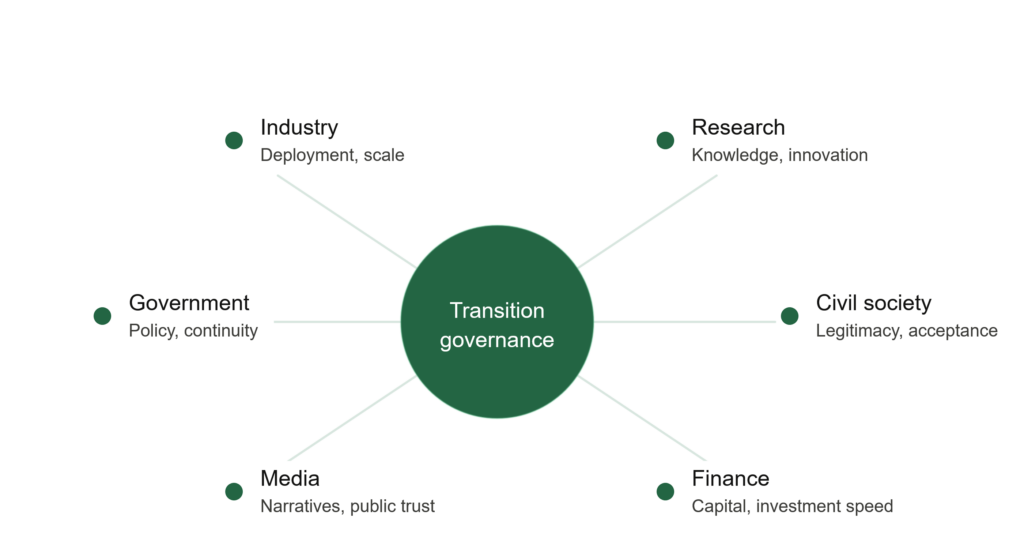
All six are capable of either accelerating or constraining transitions. And all six are necessary for governing large-scale transformation in practice.
Systemic transitions do not coordinate themselves. They require continuous political, financial and societal alignment over long time horizons.
One of the central paradoxes of Europe’s transition policy may therefore be this:
Europe is attempting to govern post-silo transitions through largely silo-based institutional architectures.
Europe has already learned how to build innovation ecosystems.
The next challenge may be determining which governance arrangements are capable of coordinating systemic transitions in practice, and whether existing partnerships can evolve to play that role.
For more information