
Interpack 2026: packaging as a global business machine
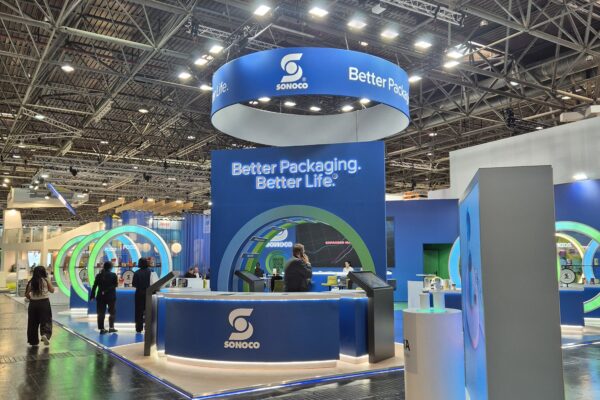
The first event was Interpack in Düsseldorf, the world’s largest packaging fair.
Even after visiting before, the scale of the fair is still difficult to comprehend. Around twenty massive exhibition halls are filled with packaging materials, packaging machines, converting technologies, processing equipment, robotics and automation from pretty much every part of the globe. Everything about the event communicates one thing clearly: packaging is an enormous global business, and single-use packaging is at its heart.
Compared to my previous visit three years ago, one positive change was visible immediately. The most obvious greenwashing had largely disappeared, and it only seemed to be done mostly by vendors coming from outside Europe. Sustainability claims appeared more cautious and grounded than before, most likely thanks to the Green Claims Directive.
At the same time, however, something else had changed, and not necessarily for the better: sustainability itself no longer seemed to be at the centre of the conversation. In discussions and presentations, a recurring message emerged: consumers are no longer prioritising sustainability in the same way they did a few years ago. Economic uncertainty, inflation and geopolitical tensions are shifting attention elsewhere.
But should sustainability only matter when consumers actively demand it?
Personally, I would not want sustainability to be a premium feature or a niche purchasing decision. I want it to be the baseline. Climate change, biodiversity loss and resource scarcity do not disappear because public attention fluctuates. If I buy a packaged product, I should be able to trust that the industry is handling its recycling and lifecycle appropriately.
Packaging has an enormous impact on our daily lives and on planetary well-being. Every consumer finance this industry continuously through everyday purchases, often without realising how much of the product price is connected to packaging systems, materials and logistics. At the moment we are seeing an increase in plastic prices as well due to the situation in the Middle east, which will result even in higher single-use costs.
Yet much of the innovation focus still appears to revolve around traditional selling points: performance, appearance & decoration, shelf impact and premium feel. Recyclability, simplicity and circularity too often remain secondary considerations.
For years, many of us working in the circular economy have hoped to see stronger movement toward closing material loops, reducing unnecessary complexity and prioritising recyclable solutions over decorative or difficult-to-recycle material combinations.
And despite increasing discussion around packaging reuse globally, reusable B2C packaging remained surprisingly invisible at Interpack. Only one vendor seemed to touch upon the topic this year which highlights the point even more: this is the fair for single-use packaging.
That observation made the contrast to the second event even stronger.
Reuse Economy Expo: a vision beyond single-use
The second fair I visited was the Reuse Economy Expo in Paris.
While the event covered reuse topics more broadly, packaging reuse was one of its central themes. The atmosphere was very different from Interpack. Smaller scale, less polished and less commercially dominant, but full of urgency, experimentation and belief that material-use systems must fundamentally change.
Anyone who has worked closely with materials understands that recycling alone cannot solve resource challenges indefinitely. Materials degrade over time. Polymer chains shorten during recycling. Fibres weaken. Significant amounts of energy are consumed during extrusion or repulping processes. In most cases, the output material quality becomes lower than the original and/or part of the material is lost in the conversion process. Recycling remains essential and it is needed to ensure the circularity and close the material loop, but it should not be the first loop by default.
Reuse extends the lifetime of products such as packaging before they enter recycling processes at all. It maintains product value and preserves material value longer thus reducing the need for virgin raw materials. This is why reuse is increasingly important. Not because every packaging application should immediately become reusable, but because we urgently need to identify the use cases where reuse creates the highest environmental and systemic benefits.
At the same time, the challenges are very real.
Reuse systems remain economically challenging. Significant investments are required in collection networks, logistics and washing infrastructure, while standardisation challenges and consumer convenience requirements create additional barriers. At the same time, reuse must compete with highly optimised single-use systems that already benefit from established infrastructure, mature supply chains and economies of scale. As a result, reuse remains a niche rather than a mainstream solution in many markets. But despite these difficulties, there was something deeply encouraging about the event. Companies, cities, policymakers and innovators were genuinely trying to redesign systems rather than simply optimise the existing linear model. At least from my perspective, this kind of system-level change feels far more meaningful than the incremental optimisation of single-use packaging systems that has been ongoing for decades.
One particularly symbolic moment was seeing French President Emmanuel Macron visit the expo and engage directly with exhibitors. The visit also highlighted how political leadership can accelerate systemic change. France appears determined to position itself at the forefront of the reuse transition, while many other countries, including Finland, are still defining their approach.
The visit also highlighted the importance of political leadership in accelerating systemic change, something urgently needed to strengthen resilience, improve material self-sufficiency and reduce dependency on virgin resources – as I already mentioned, are getting more and more expensive.
Packaging needs a broader purpose again
After experiencing both events within one week, one thought remained with me: the packaging industry stands at a crossroads. One path continues to optimise packaging primarily for shelf life, consumption, branding and sales performance. The other tries to rethink how materials and consumables flow through society within planetary boundaries.
Packaging has been one of the key innovations enabling global trade, modern food systems and improved quality of life. It protects products, prevents waste and supports efficient supply chains that billions of people rely on every day. At the same time, our understanding of the environmental consequences of today’s linear material systems has grown significantly. We are becoming increasingly aware of how resource extraction, waste generation and material losses affect climate, biodiversity, resource security and the resilience of our societies. As society’s expectations evolve, packaging must evolve alongside them. The question is no longer whether packaging is needed, but how packaging systems can continue to deliver these benefits while operating within planetary boundaries.
If sustainability becomes secondary whenever economic pressure increases, we risk losing valuable time in addressing challenges that will not wait for market cycles to improve. The future cannot rely endlessly on extracting virgin materials, using them briefly and then attempting to manage the resulting waste afterwards. More durable systems, economically viable circular business models and long-term regulatory direction will all be needed. Innovation also needs to look beyond short-term consumer trends and quarterly optimisation.
At the same time, another question emerged to me: who will lead the transition toward reuse? Will it be the traditional packaging industry itself, adapting its business models and infrastructure toward circular systems? Or will reuse create an entirely new industry around logistics, washing, tracking, reverse supply chains and shared infrastructure?
The contrast between Düsseldorf and Paris was not simply a contrast between two trade fairs. It was a glimpse of two competing visions for the future of packaging. One focuses on making today’s system more efficient. The other asks whether the system itself needs to change. The answer will likely shape not only the future of packaging, but also how we use materials and resources in the decades ahead.
For more information