The Business Finland-cofunded CEIWA project developed solutions for more sustainable and circular use of water in industrial processes, addressing digitalisation, water treatment technologies, pollutant management and regulatory aspects.
The project brought together industrial and academic partners to develop new approaches for managing complex industrial water systems and enabling more efficient use, treatment and reuse of water.
The project ran from 1 March 2021 to 30 September 2023, with a total budget of €6.32 million.
Sustainable and circular industrial water management
The management of complex industrial water systems requires new tools and approaches to improve efficiency and enable more sustainable use of water resources.
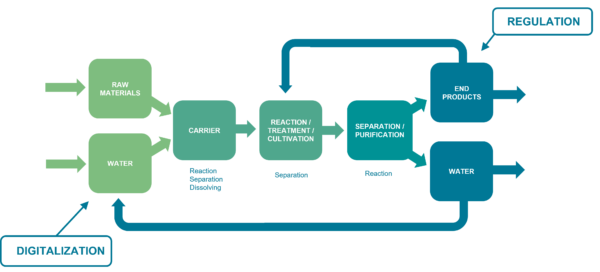
Water systems intersect with all sections of society and industry, creating opportunities to generate additional value through the application of circular economy principles. Growing demand for freshwater, climate change, increasing pollution and stricter environmental legislation highlight the need for more efficient and sustainable approaches to water use and management.
The CEIWA project addressed these challenges in industrial processes by developing solutions related to digitalisation, technology development, management of different pollutants and legislative aspects.
Role of water in industrial processes
What was developed
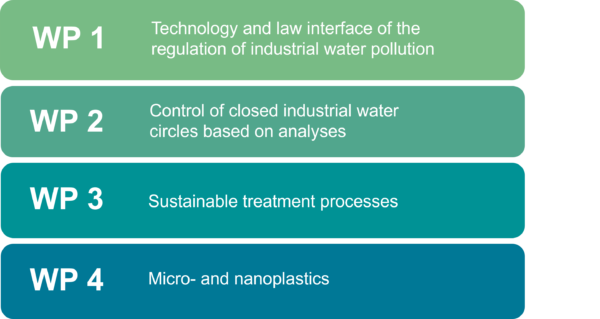
The CEIWA project approached the challenges of industrial water management from four perspectives:
- Technology and law interface of industrial water pollution regulation
- Developing approaches at the interface of technology and regulation to address industrial water pollution and the requirements of environmental legislation.
- Control of closed industrial water cycles based on analyses
- Developing methods for controlling closed industrial water cycles based on water analyses and data.
- Sustainable treatment processes
- Developing sustainable technologies and treatment processes for industrial water management.
- Micro- and nanoplastics
- Addressing the occurrence, management and treatment of micro- and nanoplastics in industrial water systems.
CEIWA work package structure
The project’s four work areas addressed industrial water pollution regulation, closed industrial water cycles, sustainable treatment processes, and micro- and nanoplastics.
Collaboration across industry and research
CEIWA brought together companies and research organisations to develop solutions for sustainable industrial water management.
Industrial partners
Andritz · Kemira · Teollisuuden Vesi · UPM · Valmet
The project also included parallel projects with Fortum, Gasum and Platform of Trust.
Research organisations
Tampere University · University of Helsinki · University of Oulu · University of Eastern Finland · LUT University · VTT Technical Research Centre of Finland
Coordinated by CLIC Innovation
CEIWA Final Report
The final report presents the project’s work, results and outcomes related to sustainable, safe and resource-efficient industrial water cycles.
Contact

Anna Tenhunen-Lunkka
Head of Circular Economy
Tel. +358 40 486 8713
anna.tenhunen-lunkka(at)clicinnovation.fi